













Transaction Center
Time to bring it home. Find zipForm®, transaction tools, and all the closing resources you'll need. Except for the champagne — that's on you.
View the latest sales and price numbers. Find out where sales will be in upcoming months.
Get a roundup of weekly economic and market news that matters to real estate and your business.
Gain insights through interactive dashboards and downloadable infographic reports.
All Shareable Reports All Interactive DashboardsCatch up with the latest outreaches and webinars by the Research and Economics team.
C.A.R. conducts survey research with members and consumers on a regular basis to get a better understanding of the housing market and the real estate industry.
California Model MLS Rules, Issues Briefing Papers, and other articles and materials related to MLS policy.
Looking for information on how to file an interboard arbitration complaint? You've come to the right place! Find the rules, timeline and filing documents here.
Summaries and photos of California REALTORS® who violated the Code of Ethics and were disciplined with a fine, letter of reprimand, suspension, or expulsion.
The most recent edition of the Code of Ethics and Standards of Practice of the National Association of REALTORS® along with other important links to NAR information.
The California Professional Standards Reference Manual, Local Association Forms, NAR materials and other materials related to Code of Ethics enforcement and arbitration.
Designed to expand housing access, Proposition 37 proposes a $25 billion state bond program providing eligible middle-income homebuyers with fixed-rate second mortgages covering up to 17% toward the purchase of newly constructed homes.
C.A.R. advocates for REALTOR® issues in Washington D.C., Sacramento and in city and county governments throughout California.
CREPAC, LCRC, IMPAC, ALF and the RAF comprise C.A.R.'s political fundraising arm.
The RAA: Protecting REALTORS® and Homeownership REALTOR® Action FundC.A.R. Senior Vice President of Government Affairs Sanjay Wagle sits down with California Insurance Commissioner Ricardo Lara to discuss the current state of California’s insurance market,
Learn how you can make a difference, by getting involved yourself or by passing along valuable information to your clients.


|
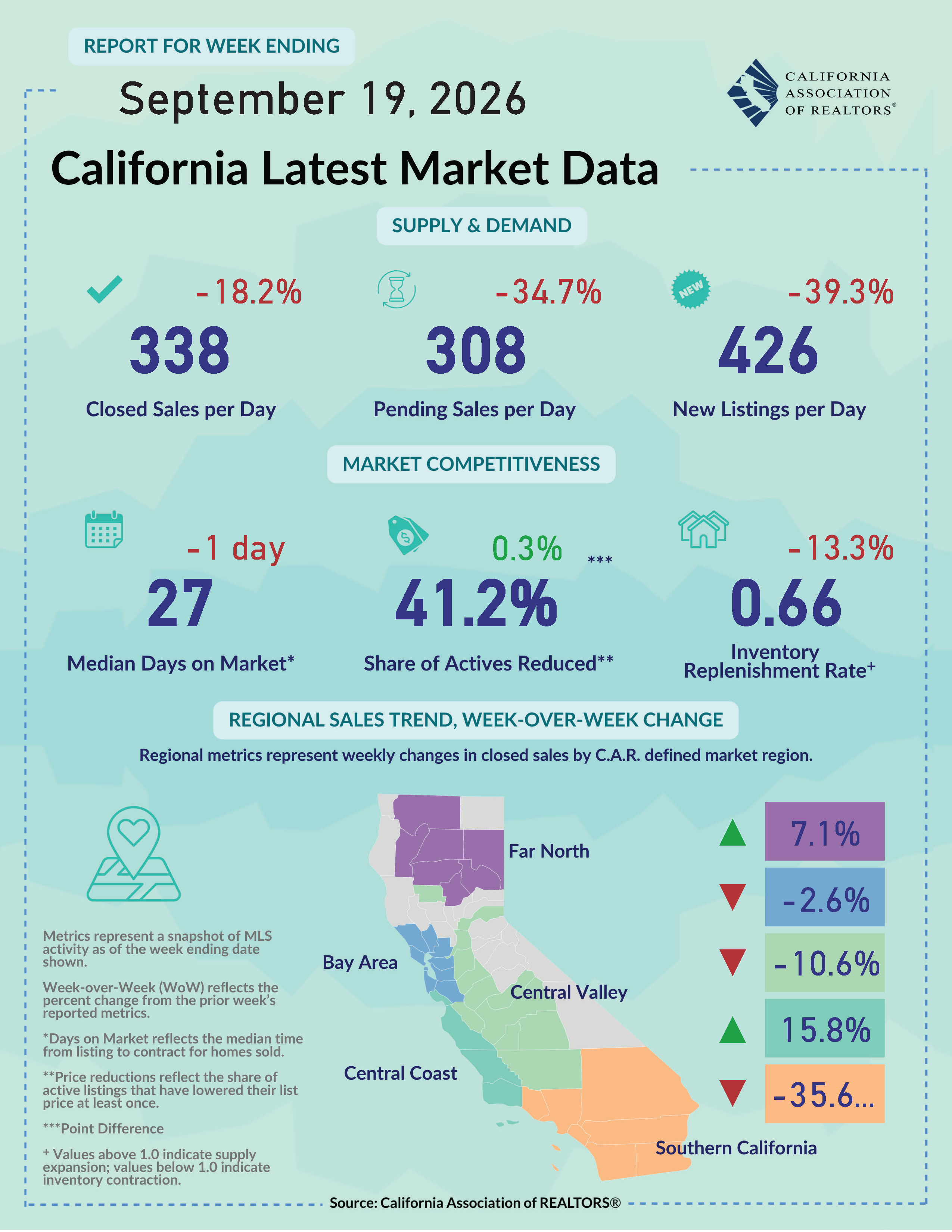
September 28, 2026 - Recent housing data point to a market that may undergo further adjustments in the coming months as borrowing costs rise and economic uncertainty persists. Mortgage rates have reached a 30-month high, purchase demand has weakened, and new home sales remain volatile despite an increase in August. Foreclosure filings have also risen from a year ago, suggesting that more homeowners are facing financial strain. Affordability constraints, elevated energy prices, and tighter monetary policy will likely create additional headwinds in the months ahead. Despite these challenges, solid homeowner equity, disciplined lending, and continued interest in homeownership should help the market weather these pressures. Mortgage rates keep climbing: The average 30-year fixed mortgage rate jumped to 7.50% as of September 28th and reached the highest level since April 2024, according to Mortgage News Daily’s data. The Middle East conflict continues to put upward pressure on energy prices. With Iran’s proposal to reopen the Strait of Hormuz being turned down President Trump, the stalemate between the two countries lingers on. Bond market reacted to the news by pushing yields higher, with the 10-year yield climbing above 5.2% and the 30-year bond yield topping 5.5%, both traded around multi-year highs. Geopolitical uncertainty, stronger-than-expected economic growth, and Fed policymakers signaling more rate increases to come all contributed to upward pressure on bond yields and mortgage rates. With rates hitting highest levels in almost 30 months, home purchase applications have been declining as costs of borrowing soared and homebuyers pulled back. For the week ending September 18, 2026, mortgage application for purchased loans dropped 11% from the same week one year ago, according to Mortgage Bankers Association weekly survey. As inflation concerns persist and monetary policy expected to be tight in the near term, housing demand could remain soft for the fall homebuying season. New home sales bounce back to an eight-month high despite higher mortgage rates: Sales of newly constructed single-family homes in the U.S. rebounded solidly with an increase of 6.4% to 684k from July’s 643k, reaching an eight-month high in August. On a year-over-year basis, the number of new homes sold last month remained below its year-ago level, with sales in August 2026 down 2.0% from last year. Mortgage rates buydowns, price reductions, and other incentives offered by builders might have driven more budget-conscious buyers towards purchasing new construction properties as mortgage rates climbed to 30-month highs. At the regional level, the West fell sharply in new housing demand, with August sales declining 15.2% from July and plunging 26.8% from August 2025. Meanwhile, as new home sales improved at the national level, for-sale properties at the end of the month stabilized with months of supply dipping to 8.5 months from 9 months recorded in the prior month but were unchanged from the level recorded in August 2025. With the Middle East conflict continuing to apply upward pressure on mortgage rates, the market for newly constructed homes could remain volatile in the months to come. Foreclosure activity inches up as more homeowners face financial challenges: U.S. foreclosure filings in August edged up slightly from the prior month but increase more substantially from 12 months, according to the latest foreclosure data released by ATTOM. At the national level, there were a total of 40,277 properties with foreclosure filings last month, an increase of 1% from July and a surge of 13% from August 2025. Nationwide, one in every 3,569 housing units had a foreclosure filing last month, with South Carolina, Nevada, and Florida having the worst foreclosure rates. California had one foreclosure filing in every 3,291 homes and was ranked the 15th highest among all states in August. While the sharp increase in filings in the U.S. from last year suggest that more homeowners continue to face financial strain compared to a year ago, strong homeowner equity and disciplined lending practices continue to put a cap on default activity as the broader housing market remains resilient. Home size has not changed much over the past 10 years: According to C.A.R.’s 2026 Housing Market Survey, the median price of homes purchased reached a series high of $799,945—about 3% above a year earlier and 52% above the 2017 level of $525,000. Despite the increase, the size of a typical home purchased remained about 1,700 square feet, essentially unchanged over the past decade. Detached single-family homes – which usually have higher prices than other alternatives - lost market share over the years, accounting for 72.4% of purchases in 2026, down from 78.0% in 2017. Higher mortgage rates and the lock-in effect have constrained supply and pushed some buyers toward more affordable options. Meanwhile, condominiums and townhomes have not gained much ground, with their share inching up to 15.1% in 2026 from 14.6% in 2017. Higher HOA dues, insurance costs, and financing challenges are likely the primary factors that place a cap on the market share. Looking ahead, the size of homes purchased are unlikely to change meaningfully as affordability will remain a hurdle for buyers in the near term. Homeownership aspiration is still high, especially among younger generations: Despite higher home prices and elevated borrowing costs, many California renters still want to buy a home eventually, and this homeownership aspiration is strongest among the youngest cohorts, according to the latest C.A.R.’s Renter Survey. About half of all renters rate owning a home as either very important or extremely important, but that share rises sharply by generation: roughly two-thirds of Gen Z renters and more than half of Millennials say it is very important or extremely important. Gen Z and Millennials also lead in stated intent to buy at some point in the future, signaling that the desire to own has not faded with affordability pressures. Nine in ten renters cite advantages of owning over renting, and three quarters of all renters — and at least four out of five Gen Z and Millennial renters — recognize social benefits of homeownership. Taken together, the findings suggest that younger generations view homeownership not merely as a financial goal but as a core marker of stability and belonging. Note: This summary report gets updated every Monday by 6:00 pm PST. Feel free to email us at [email protected] if you have any questions and/or feedback.
|
|